In this post I will show you an example whose goal is to create an infrastructure that not only allows you to create an AKS, a Kubernetes managed on the Azure cloud provider, but also to access it completely privately, creating everything necessary for this via a dedicated P2S VPN.
Furthermore, the AKS will be able to use not only a system node pool, but also a node pool of Linux machines and another of Windows machines.
Let’s now describe the cloud architecture that will be created with this Terraform project example.
AKS cloud architecture with Linux and Windows nodepools reachable via private VPN
In the previous post, Boost Your EKS Efficiency: Migrating from Cluster-Autoscaler to Karpenter, we added Karpenter to our AWS EKS reachable by private VPN and created via Terraform. We can then deploy our applications and scale them in the most appropriate way. However, we also need to be able to monitor our applications and the infrastructure they use. But what is the fastest and most efficient way to monitor a Kubernetes cluster and its nodes, both Linux and Windows?
There is a stack called kube-prometheus that was created specifically to provide a ready-made and complete solution that includes everything needed to monitor your Kubernetes cluster. In this way, in one go we install not only Prometheus, Grafana and also other necessary software such as the exporter for Windows nodes, but we already have all the configurations, dashboards and alarms ready, prepared by a specialized community.
Kubernetes cluster monitoring using kube-prometheus
In this post we will see how to install kube-prometheus on our test infrastructure via Terraform in the fastest way to be ready to monitor our microservices.
Let’s now see how to deploy Karpenter on EKS via Terraform and then how to migrate from cluster-autoscaler to Karpenter.
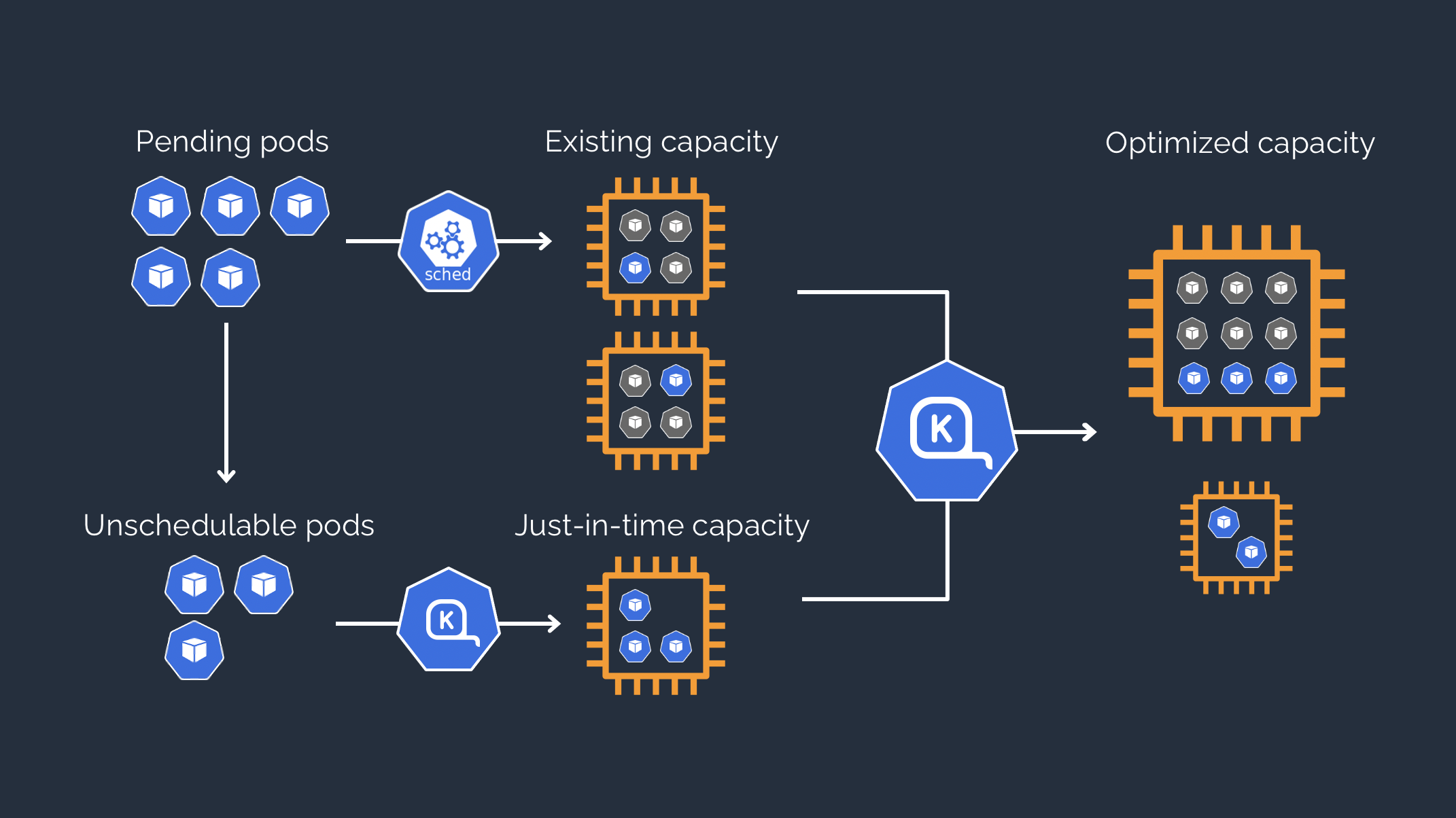
We do this because Karpenter is a sort of evolution of cluster-autoscaler and has several advantages: not only is it faster and allows us to go beyond the constraints of managed node groups, but it allows us to better optimize costs and make development teams more autonomous.
How Karpenter works – original image from https://karpenter.sh/
This website uses cookies to improve your experience. We'll assume you're ok with this, but you can opt-out if you wish.Accept
Privacy & Cookies Policy
Privacy Overview
This website uses cookies to improve your experience while you navigate through the website. Out of these, the cookies that are categorized as necessary are stored on your browser as they are essential for the working of basic functionalities of the website. We also use third-party cookies that help us analyze and understand how you use this website. These cookies will be stored in your browser only with your consent. You also have the option to opt-out of these cookies. But opting out of some of these cookies may affect your browsing experience.
Necessary cookies are absolutely essential for the website to function properly. This category only includes cookies that ensures basic functionalities and security features of the website. These cookies do not store any personal information.
Any cookies that may not be particularly necessary for the website to function and is used specifically to collect user personal data via analytics, ads, other embedded contents are termed as non-necessary cookies. It is mandatory to procure user consent prior to running these cookies on your website.